Enlarged Pores: What Your Skin Is Really Trying to Tell You (and the 3 Game-Changing Ingredients)

Let's start with the bad news. A pore isn't a door. It has no muscles, no hinges—nothing that opens or closes at will. No cold water, no ice cubes, and no miracle mask is going to «tighten» anything.
📌 See also: Blackhead Treatment
The good news? Their appearance, on the other hand, requires effort. And in this area, science has a lot to offer. But we still need to understand what’s really happening beneath the surface.
What exactly is a pore?
Two families coexist on your face.
Visit sweat pores wick away sweat. They are tiny, almost invisible, and do not pose any aesthetic issues.
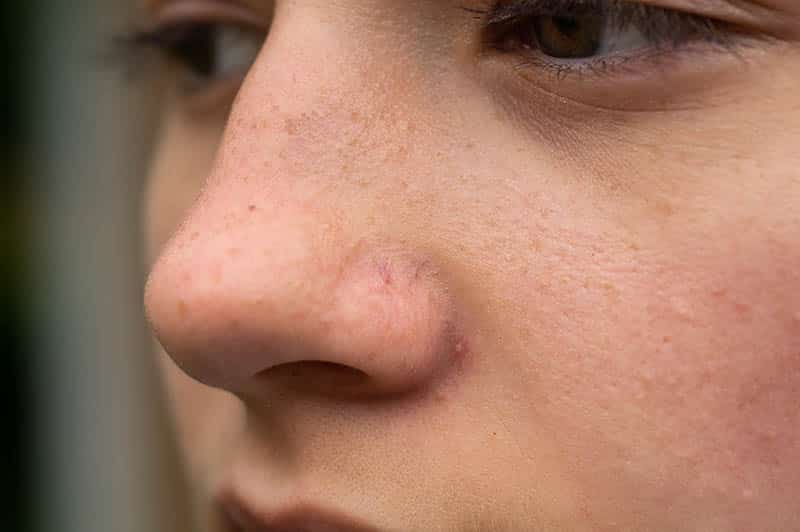
Visit sebaceous pores are connected to a gland that produces sebum. It is their opening—the ostium—that we refer to when we talk about «enlarged pores.» They are concentrated in the T-zone: the nose, forehead, and chin. This is where the density of sebaceous glands is highest.
A visible pore is therefore not a flaw. It’s a gland doing its job.
Why do some people become visible?
Sebum production
The more a gland produces, the more the drainage channel mechanically widens. It’s just basic plumbing. Oily skin, larger pores: the correlation is direct.
On average, men have more sebaceous glands, which are also more active. This often results in more noticeable pores.
Hormones
Puberty, menstrual cycle, pregnancy, menopause. Androgens stimulate sebum production. Your pores follow suit.
The Weather
After age 30, the collagen that provides structure around the pores begins to diminish. The pore walls lose their firmness, the pores sag, and take on an elongated, teardrop shape, especially on the cheeks. It’s no longer a matter of sebum; it’s a matter of support.
The sun
UV rays break down collagen and thicken the stratum corneum. It’s a double whammy: less structural support around the pore, more clogs inside it.
Genetics
Unfair, but true. Some skin types are simply wired to produce more.
The connection to blackheads
A clogged pore contains a mixture of sebum, dead skin cells, and pollution. When exposed to air, this plug oxidizes and turns black: this is an open comedone.
The problem is that this plug stretches the pore from the inside. When this happens repeatedly over the years, the effect becomes structural. The pore retains the memory of what stretched it.
The three assets that are truly backed by data
Niacinamide (vitamin B3). At a concentration of 4–5 %, it regulates sebum production and strengthens the matrix around the pore. It is the most well-documented active ingredient for this specific purpose. Visible results appear in 8 to 12 weeks, not in 3 days.
Salicylic acid (BHA). Since it is fat-soluble, it penetrates the pore and dissolves the plug right there. It is the only exfoliant that works inside the pore.
Retinoids. Retinol, retinaldehyde, and prescription tretinoin. They accelerate cell turnover and stimulate collagen production. The only approach that addresses both causes at the same time.
Azelaic acid and zinc are useful additions to the regimen for reactive skin, where retinol is poorly tolerated.
What makes it worse—and something everyone does—
Over-cleaning. Over-cleansed skin overcompensates. It produces more sebum, not less. Using a harsh foaming gel twice a day is counterproductive.
Over-exfoliating. Damaged skin barrier, inflammation, seborrheic flare-up. Two to three times a week is sufficient.
Press. A blackhead squeezed out with your fingernails leaves a dilated and often inflamed pore. You save two days, but the damage may be permanent.
Skip sunscreen. It's the most underrated pore-minimizing treatment on the market.
Do not moisten. Dehydrated oily skin produces excess oil. A non-comedogenic fluid is not an option.
What about in-office treatments?
TCA or salicylic acid peels, non-ablative fractional laser treatment, and microneedling with radiofrequency. These techniques target the perifollicular collagen and produce measurable results over the course of several sessions.
Hydrafacials and skin cleansings, on the other hand, unclog pores. The results are clear and immediate, but the effect lasts only a few weeks. It’s maintenance, not treatment.
🩺 Beauty Decoded's Review
»My advice: a simple, consistent routine—a gentle cleanser, BHA twice a week, niacinamide, a retinoid at night if your skin tolerates it, and SPF every day. Six months of consistency beats any three-week intensive regimen."
Dr Sylvain David, plastic surgeon
What the Beauty Decoded community has to say
The app's data confirms what science has shown: it's the simple, consistent routines that stand the test of time.
Visit Niacinamide 10% + Zinc 1% by The Ordinary It remains the most frequently mentioned entry-level product, with reviews such as «effectively regulates sebum and helps combat minor blemishes.» One user, however, noted an unexpected effect: when applied to the nose in the morning, the serum «opens the pores,» according to him. This suggests that at 10 %, the concentration is far from necessary for everyone.
As for BHA, the Porefectly Clear 2% Salicylic Acid by Geek and Gorgeous (4.1/5) and the BHA Blackhead Power Liquid by Cosrx (5/5) deliver the most effective results on blackheads. The Anua BHA 2% Gentle Exfoliating Toner One user summed it up simply: «Cleans pores well, isn’t irritating but is effective, and is affordable.».
For skin that doesn't tolerate retinol, azelaic acid steps in. The 10% Azelaic Acid Booster by Paula’s Choice gathering nuanced and honest opinions and the Aroma-Zone 10% Azelaic Acid Serum (4.3/5, 19 reviews) offers an affordable alternative.
Special mention for the Garancia's Sulfurous Marabout Paste, which has been widely praised, even by those with sensitive skin: «It refines my skin texture and reduces blemishes,» though there is a recurring complaint that the fragrance is too strong.
Finally, a helpful reminder from the community: «blurring» products such as The POREfessional by Benefit They don't actually do anything. One review puts it bluntly: «Gives a smooth feel to the touch, effectively blurs pores, but no significant difference.» It's makeup, and that's perfectly fine—as long as you don't expect anything else.
Decode Your Own Products
Is your cleansing gel too harsh? Does your cream contain a known comedogenic ingredient? Does your niacinamide serum have a high enough concentration?
Download the free Beauty Decoded app (iOS and Android), scan the barcode on your products and get a complete analysis of their INCI, a score based on your skin type, and reviews from a community that actually tests the products—all in just a few seconds.
Because a good routine doesn't start with a purchase. It starts with understanding what you already have in your bathroom.
Make the right choices for your skin
Say goodbye to unnecessary get visible results!
Our artificial intelligence recommends personalized cosmetics.