Retinol, acids, 10 steps: the perfect routine that damages your skin

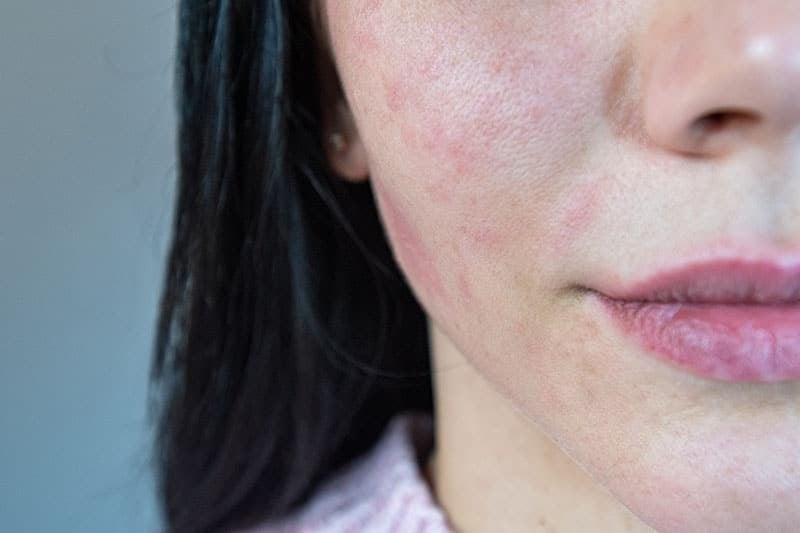
Tight, pulling skin. Redness that just won’t go away. A burning sensation at the slightest breeze. More and more users are describing these symptoms after piling on serums, acids, and anti-aging creams in routines that have become endless. The paradox is cruel: in their eagerness to do the right thing, they end up damaging what they were trying to protect.
📌 See also: Combating Redness
Layering: A Strategy That Backfires on the Skin
This phenomenon has a name: the multilayering. Originating in South Korea, this approach involves layering skincare products. Double cleansing, toner, serum, ampoule, moisturizer, sunscreen. Ten steps—sometimes more.
This isn’t just a matter of personal taste. Skin sensitization is a cumulative process: every preservative, every fragrance, and every excipient applied daily increases the likelihood that an allergic reaction will eventually occur. The longer the list gets, the more entry points there are.
Two assets, the same mechanism, double the risk
Quantity isn't the whole story. The heart of the matter is interactions.
Retinol (a vitamin A derivative), glycolic acid (an AHA), and salicylic acid (a BHA) all work on the same principle: accelerating cell turnover. To achieve this, they deliberately weaken the stratum corneum—that thin surface barrier that retains moisture and blocks external aggressors.
Used separately and systematically, these active ingredients are valuable. When layered on top of each other on the same night, they strip away a barrier that’s already under stress.
How can you tell when you’ve reached the tipping point? Tightness, widespread redness, and a burning sensation when the skin comes into contact with water. These signs don’t mean the product is «working.» They indicate that the skin’s barrier is breaking down.
Retinol rewards patience, not haste
Even when used on its own, retinol is often used incorrectly. The idea that a higher dose would produce faster results is biologically incorrect.
«It’s three times a week in the evening, then we increase it to a maximum of five times. And even then, it depends on the skin. On sensitive skin with rosacea, retinol would be a disaster,» warns Martine Baspeyras.
It takes several weeks for the skin to adjust to a retinoid—a phase sometimes called “retinization.” Rushing the process doesn’t save time; it causes flaking and inflammation. Since November 2025, the European Union has regulated these concentrations, capping them at 0.3 % for the face and 0.05 % for the body.
A market that pushes us to do more and more
marques provides little information about these dangers. Applying products in the evening is often recommended, but the importance of gradual use is often overlooked, and risky product combinations are almost never mentioned. On some websites, there’s nothing stopping you from adding an acid toner and a retinol product side by side to your cart.
Content creators are fueling the trend. «Everyone wants miracle products, but you shouldn’t take what they say as gospel—it’s just advertising,» Martine Baspeyras points out. Mélanie’s story sums up the trap: she was following trends without knowing what she was doing, and glycolic acid ended up damaging her skin.
Good news: the skin barrier can repair itself
A reaction is almost never irreversible. «The skin goes through monthly cycles. In two or three months at most, you’ll have recovered if you’ve done what you’re supposed to,» Martine Baspeyras reassures us.
The procedure consists of four steps: stop using all harsh products, intensely moisturize, allow the skin barrier to rebuild itself, and consult a professional if there’s no improvement. In an industry that values abundance, the most effective routine is, paradoxically, the simplest one.
Beauty Decoded's Review
An effective active ingredient isn’t one that you can «feel» working. Retinol, AHAs, and BHAs all rely on controlled irritation: the skin is stressed to encourage regeneration. But this stress is beneficial only as long as it remains under control.
The rule: one active ingredient at a time, gradual introduction, a constantly hydrated skin barrier, and SPF is a must in the morning. Sunburned skin doesn’t heal faster—it heals less effectively. Minimalism isn’t a trend; it’s physiology.
Dr. Sylvain David, plastic surgeon
Community Feedback
Feedback from users of the Beauty Decoded app tells exactly the same story as that of dermatologists: It's all about technique, not power.
When it comes to retinoids, the highest-rated products are precisely those with low concentrations, designed to provide a gentle start. The serum Geek & Gorgeous 101 A-Game 5 (0.05 % retinal) It has a rating of 4.93/5 based on 21 reviews, and the most helpful comments all mention how gentle it is: «perfect for sensitive skin,» «not too strong.» However, the same product causes «breakouts all over and redness» for a user with dry skin—individual variability summed up in a single line.
Visit Dermaceutic Activ Retinol (5/5 for its 0.5 and % versions) demonstrates a positive community response: several reviews spontaneously describe the ideal routine—«I used it every other night at first, then every night,» «you only need a little product,» «make sure to moisturize your skin well.» Those who take it slow can tolerate it. Those who rush into it get a burn.
The community's verdict is clear: the products aren't the problem. It's how they're used that makes the difference.
What about you—do you really know what you're layering?
Retinol, AHAs, BHAs… these active ingredients rarely mix well. Before adding yet another serum, take a close look at your entire routine at the Beauty Decoded app (free, iOS and Android). With just one scan, you can decipher the ingredients in each product, identify incompatible active ingredients, and finally find out whether your skincare routine is actually helping your skin… or making it worse. Download Beauty Decoded and take back control of your skin.