
Skin Microbiome: Stop «Boosting» It—Protect It Instead

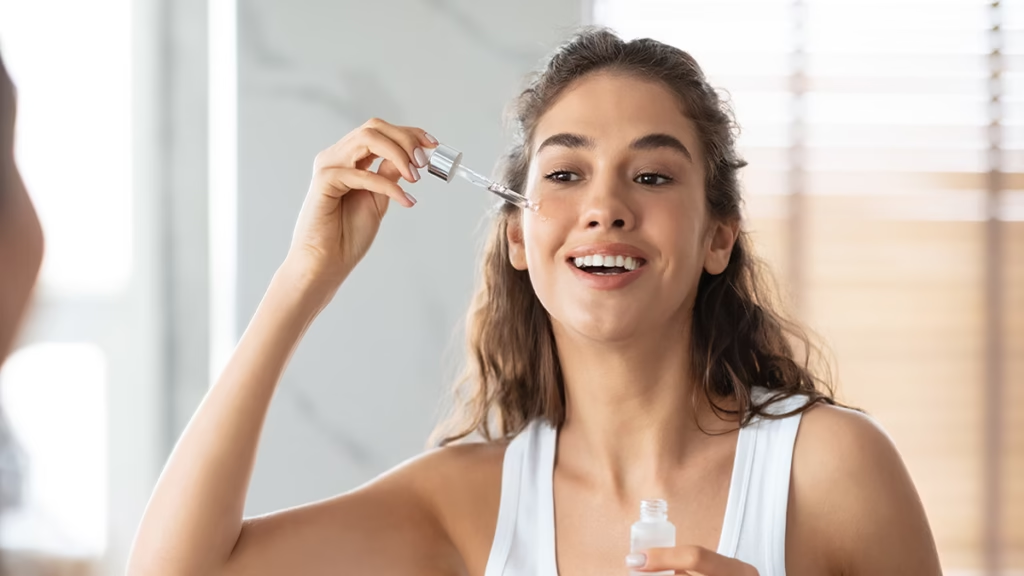
For years, we've been told the same story: healthy skin is clean skin. So we cleanse, purify, strip away impurities, and kill bacteria.
Except that the skin isn't a sterile surface, and it has no reason to become one.
Right now, your face is home to bacteria, fungi, yeast, viruses, and even tiny mites. Together, they form the skin microbiota. The word microbiome is often used as a synonym, but it has a slightly broader meaning: it also encompasses their genetic material and their interactions with the environment.
They are not just passive bystanders. They are in constant communication with the cells of the epidermis and the immune system. A balanced microbiome contributes to a healthy skin barrier. Maintaining it requires proper hygiene habits and choosing a facial care gentle on the skin's physiology.
One skin, several neighborhoods
The microbiome is not the same throughout the body. Depending on humidity, temperature, sebum levels, and anatomy, each area becomes a small ecosystem with its own inhabitants.
Broadly speaking, there are three main types of territories: the zones sebaceous (forehead, nose, upper back), the areas wet(underarms, skin folds) and the areas dry (forearm).
In areas with high sebum production, we find, in particular, Cutibacterium acnes (formerly Propionibacterium acnes), which feeds on lipids from the pilosebaceous environment. Wet areas tend to be colonized by certain Staphylococcus and Corynebacterium. Dry areas, on the other hand, generally harbor a greater diversity of bacteria.
And that's not all: age, environment, gender, and the cosmetics used also influence its composition. Each person therefore has their own microbial signature.
The Main Skin Microenvironments
| Skin area | Features | Commonly Found Microorganisms |
|---|---|---|
| Sebaceous areas | High in sebum | Cutibacterium, including C. acnes |
| Wetlands | Folds, armpits | Staphylococcus, Corynebacterium |
| Dry areas | Forearms, legs | Bacterial communities that are generally more diverse |
| Hair-sebaceous follicles | A relatively sheltered area | Cutibacterium, yeasts, and other microorganisms |
Key takeaway: Skin health depends less on the presence or absence of a bacterium than on the’population balance.
A living shield
These «commensal» bacteria (which live on us without harming us) protect their host, and the first way they do so is almost trivial: they take up the space. When the space is already occupied and the resources are being used, it is more difficult for a potentially pathogenic microorganism to establish itself.
Some go a step further and produce antimicrobial substances that inhibit other bacteria. Commensal staphylococci, for example, can help control golden staph, a bacterium closely associated with atopic dermatitis.
The microbiome also continuously interacts with the skin's immune system. These interactions help regulate the skin's defenses and promote tolerance for organisms that normally live on the skin's surface.
Microbiome and pH: An Inseparable Pair
The surface of the skin is slightly acidic. This is known as the acid mantle.
This pH plays a crucial role: it influences the structure of the skin barrier, enzyme activity, skin shedding, and the regulation of certain microbial populations. And the relationship works both ways: microorganisms produce metabolites (including organic acids), and the pH, in turn, influences which species can thrive.
This is one of the reasons why repeated cleansing and highly alkaline products can, at least temporarily, disrupt the skin's natural balance.
When Balance Is Disrupted: Dysbiosis
We're talking about dysbiosis when the composition, abundance, or function of the microbiota is disrupted.
A word of caution: the presence of dysbiosis in a skin condition does not mean it is the cause. These conditions have multiple causes, including genetics, the immune system, the skin barrier, sebum, and the environment. The microbiome is one factor among many—not the sole culprit.
Atopic dermatitis
This is one of the best-documented examples. During flare-ups, bacterial diversity may decrease while golden staph is spreading.
This bacterium can produce toxins and enzymes that fuel inflammation and further damage the barrier. It’s a vicious cycle: a weakened barrier promotes changes in the microbiota, which can in turn worsen inflammation.
Acne
The case of Cutibacterium acnes clearly shows just how much more nuanced the issue is than simply saying, «Bacteria are bad.».
This bacterium is naturally present on healthy skin. Acne is therefore not simply «too much” C. acnes ». Current research is focusing on the balance between these different strains (some of which are more closely associated with inflammation) and their interactions with sebum, hair follicles, and the immune system.
Rosacea
Rosacea is also associated with changes in the skin’s ecosystem. The role of the mite Demodex is being studied: its density may be higher in some people with the condition.
But again, the microbiome is just one piece of the puzzle, along with vascular, inflammatory, and immune mechanisms.
In practical terms, how can you protect your microbiome?
There's no need to «boost» anything with ten different products. The most effective strategy is also the simplest: Don't unnecessarily disrupt what's already working.
- Tailor your cleansing routine to your skin type. All too often, very hot water, alkaline soaps, and harsh physical exfoliants damage the skin barrier.
- Choose gentle cleansers and barrier-friendly skincare. Slightly acidic formulas offer physiological benefits: several studies highlight the importance of maintaining an acidic skin environment for the skin barrier and the resident microbiota.
- Keep it simple. Gentle cleansing, moisturizing tailored to your skin type, and sun protection: that’s already an excellent foundation—often more effective than a whole stack of products.
Probiotics, Prebiotics, Postbiotics: What Can We Really Expect?
The microbiome has become a goldmine for marketing. On labels, terms such as probiotics, prebiotics and postbiotics are popping up everywhere. Let's sort through them.
- A prebiotic, it is a substrate designed to promote the growth of certain beneficial microorganisms.
- Visit postbiotics refer, in a broad sense, to inactivated microorganisms and/or their components and metabolites that may have biological activity.
- Visit probiotics (live microorganisms) are the most difficult to incorporate into conventional cosmetics: it is challenging to keep living organisms in an aqueous formulation that must also meet strict criteria for microbiological safety and preservation.
These avenues are interesting, but we should remain cautious. Current data do not support the claim that all «microbiome-specific» products actually improve the skin’s ecosystem. It all depends on the microorganism or compound used, its concentration, the formulation, and the indication being studied.
So, should we take care of our microbiome?
Yes, but probably not in the way that marketing would have you believe.
The goal isn't to add bacteria to your face. It is to protect the environment in which the skin and its microbiome can function normally.
Your skin is an ecosystem where human cells and microorganisms coexist. A diverse and balanced microbial flora contributes to your body’s defenses and constantly interacts with the skin barrier and the immune system.
Taking care of your microbiome starts with simple steps: avoid over-cleansing, protect your skin’s acid mantle, limit the use of irritating products, and choose skincare products suited to your skin type.
In skincare, as is often the case, It is better to respect the skin's natural physiology than to try to change it.


