
UV exposure: Mistakes that cause your skin to age faster


Invisible. Odorless. Colorless.
Sunlight doesn't feel harsh to the touch. That is precisely what makes it so dangerous. Every time you go outside without protection, you contribute to a silent process: photoaging.
The figure is shocking. Among people with fair skin, Up to 90 % of wrinkles and age spots are caused by ultraviolet rays. Not age. Not genetics. The sun.
And they're right there behind a window. Even when the sky is gray.
See also: Summer and Your Skin: The Pros and Cons of Sun Exposure
How UV Rays Actually Penetrate the Skin
Two wavelengths, two trajectories.
UVB (280–320 nm) are absorbed into the epidermis. They are responsible for burns and inflammation. Their effect is immediate, visible, and painful.
UVA (320–400 nm) They penetrate all the way down to the dermis. Once there, they don’t burn—they destroy.
They activate enzymes that break down collagen and elastin, the two pillars of skin firmness. At the same time, they generate a surge of free radicals that increases oxidative stress and accelerates the loss of elasticity.
No sensation. No warning signs. Just a dermal matrix that’s breaking down, minute by minute.
80 to 90 % of the marques do not come from time
Research conducted on individuals with light skin types points to the same conclusion: 80 to 90 % of the signs of skin aging are directly attributable to the sun.
The comparison speaks for itself. Starting in their 50s, sunbathers have more deep wrinkles and pigmentation issues than those who have limited their sun exposure. And the gap does not close. It remains measurable even after age 70.
That is the very definition of a cumulative effect. Each exposure builds on the previous one, and nothing is erased.
The number we can't ignore
In France, there are each year between 141,000 and 243,500 cases of skin cancer, including approximately 18,000 cases of melanoma.
More than 85 % are believed to be directly linked to excessive exposure to UV radiation, whether natural or artificial.
It's no longer just a matter of aesthetics.
Clouds and windows: two false shields
This is where most of the damage occurs. Because these are the situations where no one is taking precautions.
The sky is overcast. Up to 90 % of UV radiation passes through certain clouds. Worse still: a scattering effect can increase ground-level radiation by nearly 25 %. A gray day is not a day without UV radiation. It can actually be a day with even more UV radiation.
Standard glazing. They effectively block UVB rays. They let almost all UVA rays through. In other words: they prevent sunburn but don't stop skin aging.
The documented case of a truck driver illustrates this better than any long speech. After 28 years spent sitting on the side facing the window, the left half of his face—the side exposed to the glass—showed significantly more advanced signs of aging than the right. Deeper wrinkles, thickened skin, and marked sagging. Same man, same age, same genetics. The only variable: UVA rays.
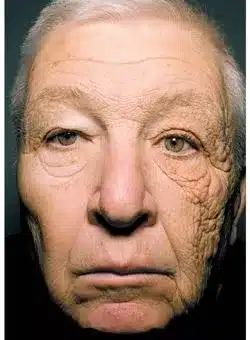
A desk near a picture window, daily car rides, a shaded patio on a cloudy day. It’s the exposures we don’t even notice that do the groundwork.
The sun is not an absolute enemy
Let's stick to the facts. A reasonable amount of exposure has real benefits.
Vitamin D : Exposing your arms and face to the sun for 5 to 30 minutes, two to three times a week, is enough to meet your needs. The goal is not to get a tan.
Mood : Serotonin production increases with daily exposure to light. Going outside is good for you—and it's not just a feeling.
The goal isn't to avoid the sun. It's to avoid the amount of sun that causes damage.
Three Strategies That Really Work
1. Filter UV rays
- A broad-spectrum sunscreen with an SPF of at least 30 in the winter and SPF 50 in the summer.
- Reapply every two hours. And always after swimming or heavy sweating.
The point everyone misses: the amount. An under-dosed SPF 50 provides actual protection equivalent to SPF 20 or 30. The number on the tube is a conditional promise.
2. Create a physical barrier
- Wide-brimmed hat, tightly woven clothing, UV 400-certified sunglasses.
- UV-blocking window films for the most exposed windows—in cars, offices, and bay windows.
Textiles are unforgettable and leave a lasting impression. That is their strength.
3. Repair and soothe
At the end of the day, a skincare product rich in moisturizing agents and antioxidants helps restore the skin barrier. This is helpful. It’s not a way to make up for lost time: nothing can replace protection applied earlier in the day.
Beauty Decoded's Review
«This driver’s case has become a textbook example, and for good reason: it isolates the variable. Same genetic makeup, same age, same lifestyle—only the exposure to UVA rays differs between the two halves of the face. This is the clearest demonstration of photoaging that one can provide.”.
Dr Sylvain David, plastic surgeon
Community Feedback
The app's data shows a clear distinction between sunscreen used at the beach and sunscreen used in daily life—and it is precisely the latter that contributes most to photoaging.
When it comes to everyday use, Korean products dominate. The Relief Sun Rice + Probiotics SPF 50+ by Beauty of Joseon remains the gold standard with 72 reviews and a 4.5/5 rating. The Hyalu-Cica Water-Fit Sun Serum by Skin1004 has a rating of 4.9 out of 5 based on 22 reviews. What do all these products have in common—as repeatedly emphasized in the comments? Comfort. «It doesn't leave your skin oily or leave white streaks, and it's very easy to apply makeup over it afterward.», as one user puts it. A good sunscreen is one you’ll want to use again the next day—and that’s what really matters.
As for health and beauty products, the Blur Sun Secure SPF 50+ by SVR is the most reviewed solar panel in the entire database (70 reviews, 4.1/5), followed by the Vichy Capital Soleil UV-Age Daily (4.9/5 based on 12 reviews) and the’Anthelios UVMune 400 Dry-Touch Gel-Cream by La Roche-Posay (4.1/5 based on 31 reviews), the only one in the group to block ultra-long UVA rays up to 400 nm.
What about the antioxidant aspect? Users have taken it on board. The C Glow Vitamin C by Geek and Gorgeous has 48 reviews with an average rating of 4.8 out of 5, the C15 Super Booster by Paula’s Choice Rated 4.8/5 based on 15 reviews. These are supportive treatments that should be understood for what they are: they help limit oxidative stress, but they do not filter out any rays.
Where the platform is quieter is in the after-sun category. Few products have been scanned, and there are few reviews. This is telling in itself: the tendency to seek repair remains marginal compared to the tendency to seek protection.
Does your sunscreen really block UVA rays?
That’s the question the packaging never clearly answers. Scan your cream at Beauty Decoded : The app provides detailed information about each filter in the formula, indicating whether it protects against UVA, UVB, or both, whether it is irritating, and whether it is suspected of being an endocrine disruptor. Free on iOS and Android, with reviews from thousands of users who have already tried it. Because the wrinkles you’ll avoid in twenty years start with the tube of sunscreen you’re using today.
Make the right choices for your skin
Say goodbye to unnecessary get visible results!
Our artificial intelligence recommends personalized cosmetics.


