
Is this azelaic acid an «Anua» scam? I’m analyzing the formula and the controversy

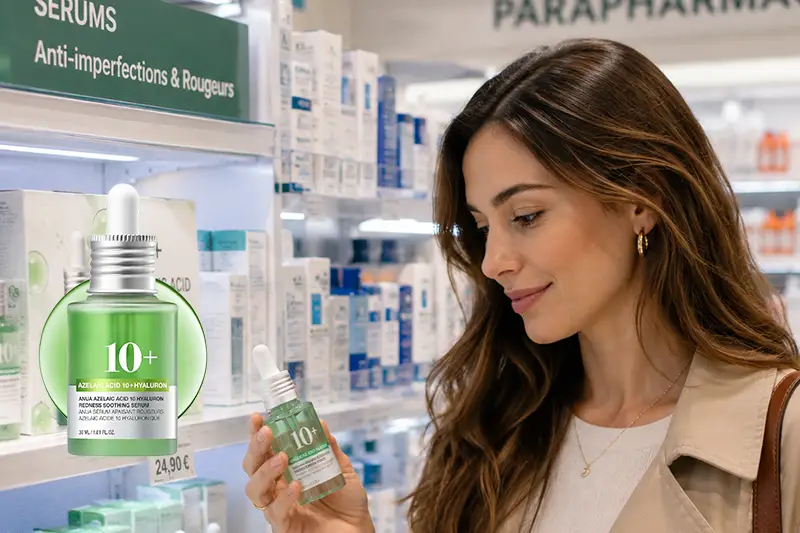
Where does the controversy come from?
The allegation: Following a reformulation, the serum’s pH is said to have increased (independent chemists report a pH close to 6), causing the azelaic acid to change to its saline form (ionized).
The fact is undisputed: yes, azelaic acid is present there primarily in its ionized form. The real question lies elsewhere: Does that make it ineffective?
📌 See also: CeraVe is joining the peptide trend with its Skin Renewing Cream—here's my take on it
Why This Is a False Accusation
Azelaic acid is a unique molecule: a diprotic dicarboxylic acid, which loses its protons at two distinct pH levels (around 4.5 and then 5.3). It is this solubilization at higher pH that makes it possible to develop formulations in a clear, fluid, liquid serum. (Instead of the creams and grainy emulsions)
The accusers« reasoning assumes that the »free acid value” (the non-ionized portion) alone determines effectiveness. This is incorrect: azelaic acid acts especially on the surface of the skin, as an antimicrobial and anti-inflammatory agent. pH is important for formulation, skin tolerance, and penetration, but a modified pH does not render the product ineffective.
The real twist: a higher pH can be an advantage
There are two types available on the market:
- a shape suspended (grainy emulsion, low pH), where the molecule floats without dissolving, like a snow globe. (ACM, Nooance, Teen Derm Isispharma)
- a shape solubilized (liquid serum, higher pH), where it is completely dissolved. (Anua)
In theory, the non-ionized form (non-liquid, in suspension) penetrates the skin barrier more effectively, but the solubilized form (liquid, dissolved) makes many more molecules available for penetration. Who wins?
L'baseline study cited in the debate compared, in vitro, two formulations of pH 3.9 (suspended) and pH 4.9(dissolved):
- skin retention higher at a pH of 4.9; ;
- ionized species flux about 5 times greater at pH 4.9 (128.4 vs. 27.7 μg/cm²/h); ;
Ref.: Li N, Wu X, Jia W, et al. Effect of Ionization and Carrier on Skin Absorption and Penetration of Azelaic Acid. Drug Dev Ind Pharm. 2012;38(8):985-994. PubMed 22111946
Explanation by Dr. David
Imagine sugar in a glass of water. As long as it remains in the form of granules at the bottom of the glass, some of the sugar is not actually available in the liquid. When it is completely dissolved, all the molecules are dispersed and available.
It's kind of the same thing with azelaic acid. In some creams or emulsions, some of the azelaic acid remains in the form of tiny suspended particles: it must first dissolve before it can penetrate the skin.
In a liquid serum with a higher pH, azelaic acid can be dissolved much more effectively. Admittedly, it then exists primarily in a so-called «ionized» form, which theoretically crosses the skin barrier less easily. But there are many more molecules immediately available to try to pass through it.
That is what the study shows: Having a theoretically very insightful approach isn't much use if a large part of the’azelaic acid remains in the form of undissolved particles. Conversely, a well-dissolved liquid form can make more azelaic acid available to the skin, even if it is more ionized.
In summary: An emulsion may contain a form that penetrates easily but must first dissolve. A liquid serum may contain a form that penetrates less easily, but many more of its molecules are already dissolved and available.
Limits to Keep in Mind
This study doesn't tell the whole story: it is in vitro, on mouse skin, compare pH 3.9 vs. 4.9 (not ~6, which is the actual pH of the serum), and does not test any brands in question. Without comparative clinical studies There is no direct evidence, so it is impossible to reach a definitive conclusion, but there is also no evidence to suggest that the product is less effective because of its pH.
Keep an eye on: derivatives
Some serums claim to contain azelaic acid but actually contain potassium azeloyl diglycinate (PAD) a modified derivative, about which there is less information available, and for which there is no guarantee that it will exactly replicate the effects of azelaic acid. Such as the A Pad from the Geek & Gorgeous brand.
The essentials
The accusation of a «scam» is based on a chemical abbreviation. The available data even show that better solubilization Azelaic acid may compensate for its lower proportion in the non-ionized form and promote its penetration into the skin.
But be careful not to go to the other extreme: this study does not prove that a serum with a pH of 6 is more more effective than a formula with a pH of 4.
The most reasonable conclusion is therefore the simplest one: Measuring the pH of a serum is not enough to determine its effectiveness.
You, too, can analyze your products
You don't have to be a chemist to understand what's in your skincare products. Simply scan your product with Beautydecoded : The app analyzes the product's composition and helps you understand its ingredients and determine whether it's right for your skin.
Search for «Beautydecoded» on the App Store or Google Play and scan your first product.


Thank you very much for this very thorough and clear explanation.