Urolithin A and skin longevity: deciphering a new ingredient

For thirty years, the skincare market sold a simple promise: to erase wrinkles. Biological research, on the other hand, was about something else. It spoke of cell senescenceof mitochondrial oxidative stressof glycation of support proteins. These are deep, measurable mechanisms on which a conventional «anti-ageing» cream had, to tell the truth, only a very limited impact.
In recent years, a term has emerged to designate a more rigorous approach: the skin longevity. It's not a new word for «anti-aging». It's a different question. Instead of asking «how to mask the signs of the times?», we ask «how to preserve the cellular functioning that keeps skin healthy?».
Cellular biology and skin aging
Skin ages according to several documented mechanisms, which act in parallel.
Cellular senescence refers to the accumulation, with age, of cells that no longer divide but don't die either. These cells secrete an inflammatory cocktail (known as SASP, senescence-associated secretory phenotype) which degrades the surrounding tissue.
Oxidative stress corresponds to an imbalance between the production of reactive oxygen species - normal by-products of cellular metabolism, amplified by UV exposure, pollution and smoking - and our cells' ability to neutralize them. Proteins, membrane lipids and DNA are damaged.
Glycation is the aberrant binding of sugars to structural proteins such as collagen and elastin, which become rigid and lose their function.
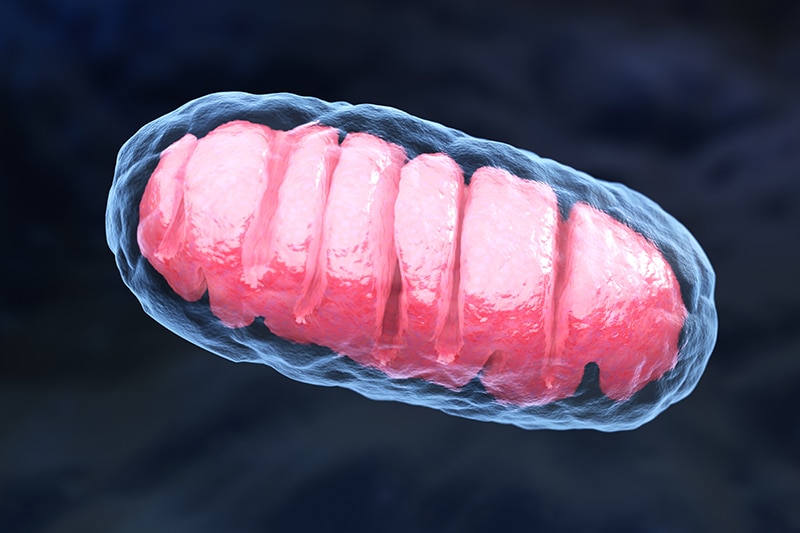
And at the heart of all this damage is an organelle: the mitochondria. The cell's energy powerhouse, the first to produce oxidizing by-products, the first to malfunction as the cell ages.
Mitophagy: the self-cleaning of mitochondria
This is where a fascinating and long-underestimated cellular mechanism comes into play: the mitophagy.
The term refers to the process by which the cell identifies its defective mitochondria and recycles them. A sort of selective intracellular sorting. When mitophagy works, dysfunctional mitochondria are eliminated before saturating the cell with oxidative stress. When it slows down - as happens with age - waste accumulates, cellular energy drops, and tissue ages more rapidly.
The discovery of the mechanisms of autophagy (the family of processes to which mitophagy belongs) earned Yoshinori Ohsumi the Nobel Prize in Medicine in 2016. So it's not a marketing concept. It's fundamental biology, on which numerous teams have been working ever since to identify molecules capable of stimulating it.
Urolithin A: an interesting postbiotic
Among the molecules studied in this context, urolithin A has built up a solid scientific track record.
It is not a nutrient found directly in food. It is a postbiotic a compound produced by the intestinal microbiota from ellagitannins - polyphenols found in pomegranates, certain nuts and raspberries. But not everyone produces it in the same quantities: part of the population lacks the bacterial profile needed to synthesize it efficiently.
Research on urolithin A has focused on its ability to stimulate mitophagy. Several clinical trials published in journals such as Nature Metabolism or Cell Reports Medicine have shown, with oral supplementation, measurable effects on mitochondrial muscle function in aging adults. This is an area of active research, with real data - not an ingredient invented for a sales pitch.
Logically, laboratories were wondering: what about cutaneous application?
The arrival of urolithin A in cosmetics
The transition from oral supplementation to topical skincare raises different issues. A molecule that is effective orally is not automatically effective cutaneously - the skin is a barrier designed not to let much through, and the penetration of an active ingredient depends on its size, polarity and formulation.
On this point, let's be clear: cosmetic application of urolithin A does not reproduce the systemic effects of a dietary supplement. In fact, the brand that markets these products explicitly states this in its own product information. We're talking here about a topical, local action on skin cells - not an intervention on global metabolism.
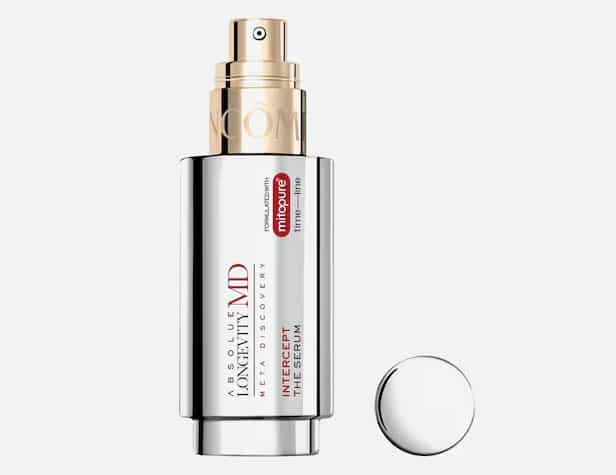
It is in this context that Lancôme skin longevity range has been developed in partnership with Swiss biotech Timeline (which markets the world's most widely distributed oral urolithin A supplement). Called Absolue Longevity MD, the collection offers three protocols segmented by the skin's apparent biological age:
- Anticipate for young skin,
- Intercept for intermediate skins (35-55 years),
- Reset for mature skin.
To our knowledge, this is the first large-scale deployment of urolithin A in cosmetics, via a 98.5 % pure micronized form called Mitopure®.
What brand tests say
Lancôme's launch is underpinned by several sets of data that are worth looking at in detail - not just to sweep them under the carpet, but to understand them properly. what each figure actually measures. It's an essential reflex for deciphering this type of communication.
On cellular mechanisms (in vitro tests)
+86 % stimulation of cellular energy (in vitro test, keratinocytes) +257 % stimulation of mitochondrial biogenesis (in vitro test, superficial skin cells)
These two figures come from experiments carried out on cells in culture, in the laboratory - not on human skin in vivo. These are mechanistic data: they indicate that the molecule does something at the cellular level, which is consistent with the literature on urolithin A. But an effect observed on keratinocytes in a Petri dish does not translate mechanically into a visible clinical effect. This shows that the biological pathway is activated, which is a necessary - but not sufficient - condition to speak of efficacy.
On visible markers (instrumental test)
+52 % skin elasticity (instrumental test, 40 people) +3 million new cells per day (instrumental test, 31 people, 22 days)
These data are more solid: they are measured objectively, on human subjects, with a device. The sample remains modest (40 and 31 people), with no placebo group specified in the elements communicated - in other words, we don't know how these figures compare with a control cream. Worth noting nonetheless.
On user self-assessment
100 % of women find their skin firmer 93 % of women find their skin looks younger than their actual age (Self-evaluation, 61 women, 3 months)
Here, we leave objective measurement and enter the world of subjective perception. Self-assessment is admissible data, but it tells us what users have to say. felt and declared - it's influenced by the product's price, packaging and sensory experience. It's not a flaw, it's just a different category of evidence. A lot of cosmetic tests are based on this; you have to know it and read it for what it is.
How to read this type of range with an INCI eye
Beyond the marketing rhetoric, let's take a look at the formulation of Intercept serum, for example. It includes :
- Urolithin A, the differentiating active ingredient, in a relatively high position on the list for this type of molecule; ;
- Niacinamide useful concentration (position 5): robust active ingredient for skin barrier, inflammation and radiance; ;
- Pro-Xylane (Hydroxypropyl Tetrahydropyrantriol) L'Oréal's patented active ingredient, with correct data on dermal glycosaminoglycans; ;
- Matrixyl (palmitoyl tetrapeptide-7 + tripeptide-1) Peptide combination with documented collagen production and inflammatory modulation; ;
- LHA (caprylol salicylic acid) Gentle exfoliant derived from salicylic acid; ;
- Hyaluronic acid in acetylated and native form: hydration and water retention; ;
- Taurine sulfur amino acid, targeted here at cellular oxidative defense.
This is what Lancôme calls its Intercept Compound™ Mitopure® + Revitofirm + Matrixyl + Niacinamide + Pro-Xylane + Taurine.
Things to be aware of: presence of’alcohol denat. in high position and presence of fragrance for reactive skin.
Things to remember
Skin longevity, as a category, is more demanding than classic anti-aging. It requires us to look at cellular mechanisms (mitophagy, senescence, glycation, oxidative stress) rather than surface effects.
Topical urolithin A is one of the most interesting active ingredients to appear in this category in recent years - not because it «works miracles», but because it is based on a real biological mechanism, documented by a solid literature, including seminal work on autophagy awarded Nobel Prize.
No cream can stop aging. But understanding what you're targeting - and knowing how to read both an INCI list and a clinical test grid - is still the best way to make an informed skincare choice.
About the author Plastic and aesthetic surgeon, founder of Beauty Decoded, a cosmetic ingredient analysis application.