
Excessive sweating: discover effective solutions to overcome it

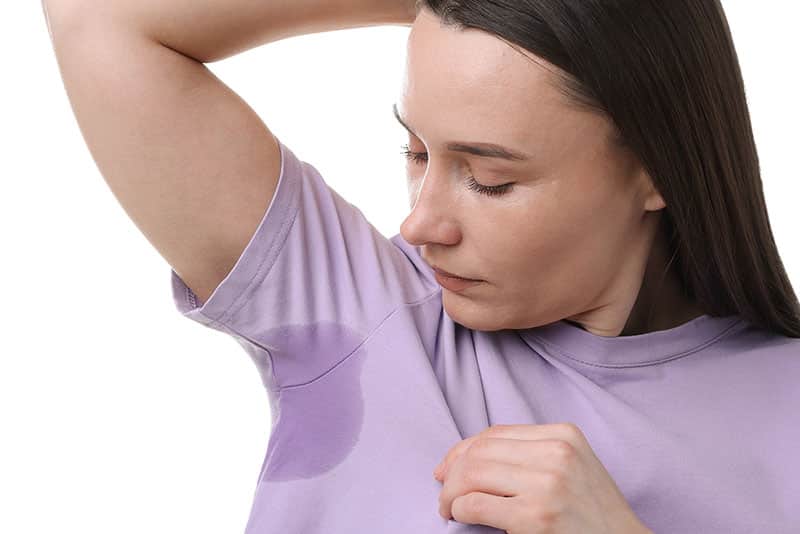
Change your T-shirt at noon. Avoid light gray. Decline a handshake. For some people, sweating isn't just a summer nuisance—it's a daily struggle.
📌 See also: Enlarged Pores: What Your Skin Is Trying to Tell You
And in most cases, the person in question has never sought medical advice. They’ve been stockpiling deodorants for ten years, thinking it’s just something they have to live with.
Sweating is normal—up to a point.
Sweating is a cooling mechanism. The body has between two and four million sweat glands. Eccrine glands, which are distributed throughout the body, produce clear sweat that is more than 99 % water. They regulate body temperature.
Apocrine glands, on the other hand, are concentrated in the armpits, the genital area, and around the areolas. They become active during puberty and secrete sweat that is richer in lipids and proteins.
Important point: Sweat itself is odorless when it leaves the body. The odor results from the breakdown of these compounds by bacteria on the skin’s surface. These are two distinct problems, and they require different solutions.
Hyperhidrosis: When It Becomes a Medical Condition
Hyperhidrosis is defined as sweating that far exceeds what is necessary for thermoregulation. It affects approximately 1 to 3 % of the population—often many more—though studies are limited by the fact that most patients never seek medical care.
Two distinct forms can be identified.
Primary Hyperhidrosis It is localized to the armpits, palms, soles of the feet, and face. It often begins during adolescence, has a familial component in about half of cases, and typically subsides during sleep. There is no identifiable underlying cause.
Secondary Hyperhidrosis It is widespread, can occur at night, and can appear at any age. It is a symptom of another condition: a thyroid disorder, diabetes, menopause, an infection, or a side effect of medication. It requires a medical evaluation.
A warning sign that requires immediate medical attention: excessive sweating that begins suddenly in adulthood or persists at night.
Deodorant or antiperspirant: they're not the same thing
This is the most common misconception, and it explains years of failure.
A deodorant It works to control odor. It uses antibacterial agents and fragrances. It does not reduce sweat volume by even one milliliter.
A antiperspirant acts on sweat flow. Aluminum salts form a temporary plug in the sweat duct and mechanically reduce the amount of sweat released.
If you sweat a lot and use deodorant, you're treating the symptom while ignoring the cause. The product does exactly what it's supposed to do. It's just not the right product.
The thing that almost no one does correctly: An antiperspirant should be applied in the evening, to clean, dry skin—not in the morning after a shower. At night, sweat production is at its lowest, which gives the aluminum salts time to form a plug. If applied in the morning to skin that’s already damp, the product is washed away before it has a chance to work. Sometimes this simple change is enough to turn around a result that was previously considered disappointing.
Let's set the record straight on aluminum salts
The issue has been a source of concern for a decade, particularly in relation to breast cancer and Alzheimer's disease.
Assessments conducted by European health authorities have not established a causal link. The SCCS reevaluated the case in 2020 and concluded that there is no risk at the concentrations authorized for cosmetic use. The matter is not yet scientifically settled—research is ongoing—but the current level of evidence does not justify forgoing an effective treatment when the discomfort is real.
So-called «natural» alternatives—alunite being the prime example—deserve a bit of clarification: potassium alum is itself an aluminum salt. The term “aluminum-free” warrants closer scrutiny.
Solutions, in order of escalation
Level 1: Basic Skills. Clothing made of natural fibers; underarm hair removal (which reduces the surface area where bacteria can multiply); limiting foods that stimulate sweating—particularly alcohol and caffeine. Helpful, but not sufficient on its own in severe cases.
Level 2: Antiperspirant with controlled strength. In addition to over-the-counter products, there are higher-concentration formulations available at pharmacies that are significantly more effective for mild to moderate hyperhidrosis.
Level 3: iontophoresis. A low-intensity electrical current applied in a water bath, primarily for the hands and feet. The treatment requires consistency: several sessions per week during the initial phase, followed by maintenance sessions. Effective, but demanding.
Level 4: botulinum toxin. When injected subcutaneously, it blocks the release of acetylcholine and neutralizes gland activation. The effect sets in within a few days and generally lasts six to nine months. It is currently the standard of care for severe axillary hyperhidrosis and is covered by insurance for certain indications.
Level 5: Systemic and surgical treatments. Oral anticholinergics, microwave therapy, or thoracic sympathectomy. The latter is a major procedure, reserved for cases where all other treatments have failed, and carries a risk of compensatory hyperhidrosis, which must be explained in detail before any decision is made.
What the Beauty Decoded community has to say
The Beauty Decoded community is scanning facial care products on a massive scale. Of the 20,000 products listed in the app, only one comes close to addressing the topic: the Spirial Shower Gel and Deodorant by SVR, which has a rating of 2.6 out of 5 based on 5 reviews—a low score based on a sample size that is too small to be conclusive.


